Ethnological Museum
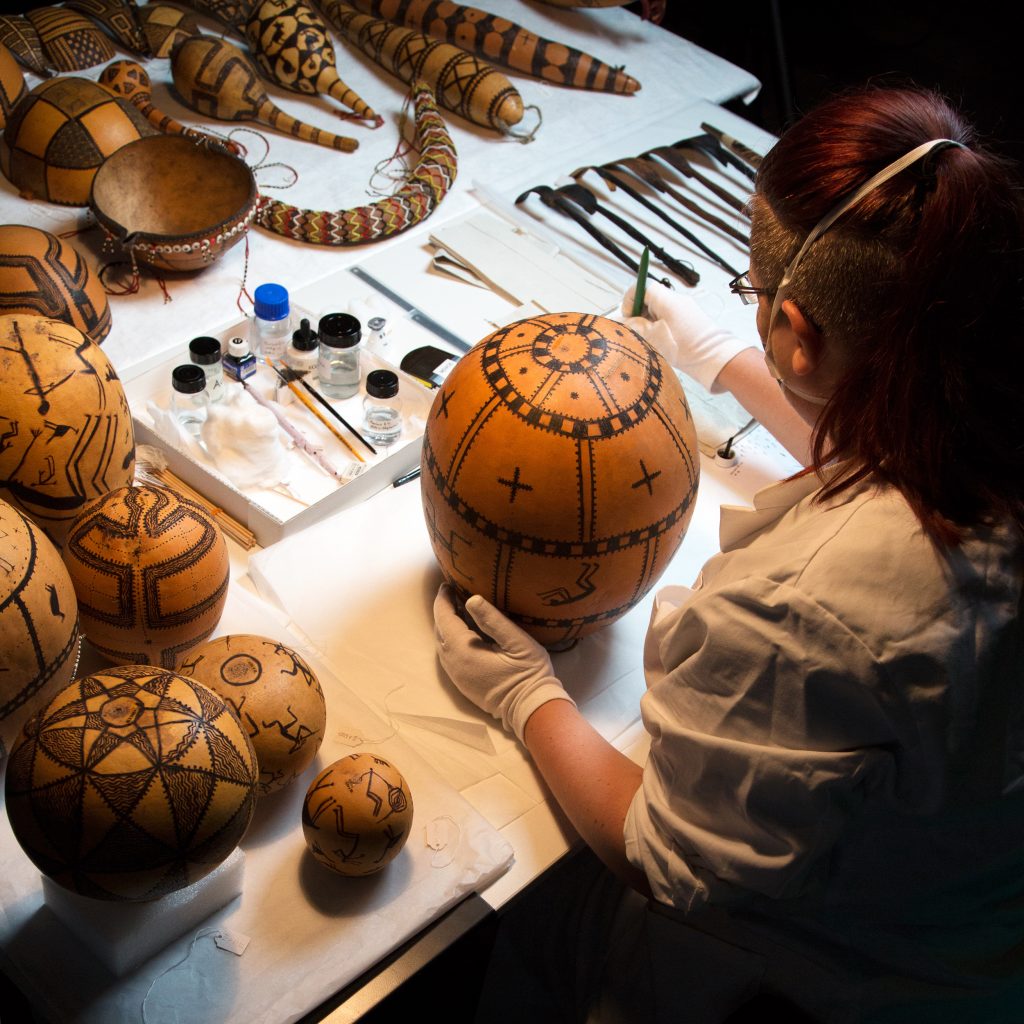
Digitising the ethnographic objects in the temporary storage facility at the Ethnologisches Museum in Dahlem, Berlin (photo: Staatliche Museen zu Berlin – Ethnologisches Museum / Mirjam Lotz, CC NC-BY-SA)
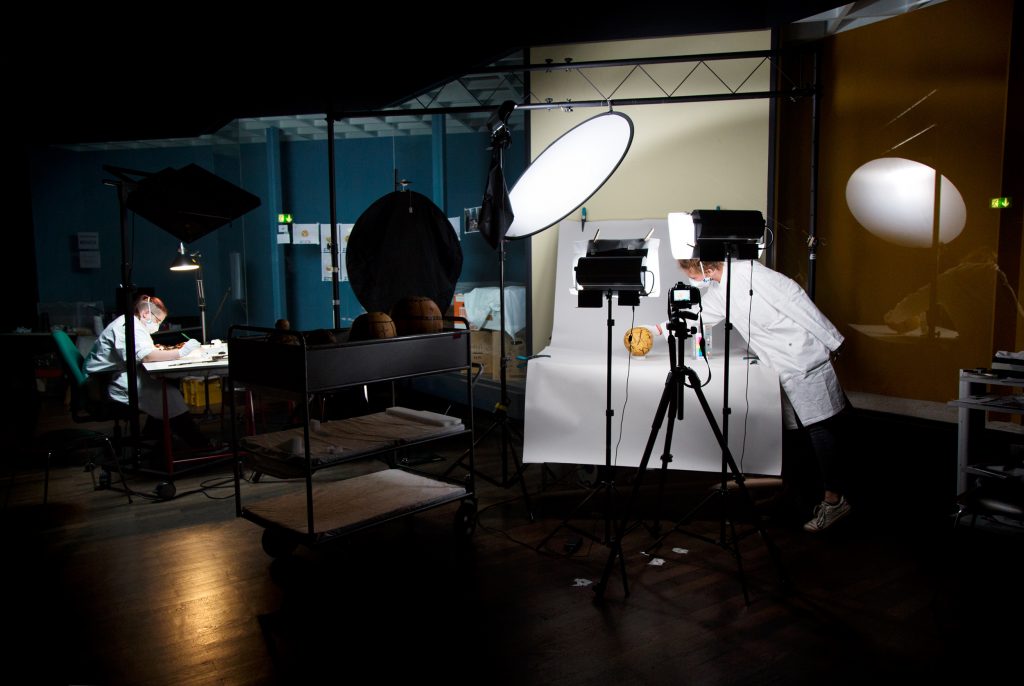
Digitising the ethnographic objects in the temporary storage facility at the Ethnologisches Museum in Dahlem, Berlin (photo: Staatliche Museen zu Berlin – Ethnologisches Museum / Mirjam Lotz, CC NC-BY-SA)
Ethnographica: holdings, scope and storage
Upon the acceptance of the Riefenstahl estate, eight aluminum transport crates, two large wooden crates and several other moving boxes arrived at the Ethnologisches Museum in Berlin. These boxes, some of which were labelled and stickered by Riefenstahl herself, contained her ethnographical collection. This comprises an estimated 700 objects or cultural belongings acquired during the time Riefenstahl spent in the Nuba Mountains and other East African regions.
Around half of the objects in the collection are cultural belongings fashioned from calabashes. There are numerous calabash bowls and vessels of various kinds with pokerwork all around their circumferences, some of which feature appliquéd textiles, glass or plastic beads, plastic bands, metal or cowrie shells. In most instances, the pokerwork consists of ornamental or geometric decorations that accentuate the shape of the calabash used. We sometimes find pokerwork images of animals and people as well as symbols or events – such as hunting scenes and domestic or interpersonal activities – on some of the larger vessels.
Among the calabashes we also find sealable bottles with leather thongs and beadwork decorations as well as filled calabashes with textile appliqué. In addition, the ethnographical estate also includes a variety of everyday objects such as bottles, wooden spoons, pelts, basketwork and fronds – as well as an Italian coffeepot and souvenir items. Spears, shields, clubs, knives and other weapons are also found in the collection, as is a large selection of jewellery: hoops made of metal or wrapped in cloth, necklaces of beads or metal, tortoise shells attached to textile strips, leather strips and pendants.
Last but not least, the collection includes musical instruments, such as two large wooden drums with skin drumheads and ten plucked instruments resembling lutes with resonating bodies made either of leather stretched across a calabash or of wood – some bearing decorations or textile strips and signs of use.
Once the items had been inventorised, 680 identification numbers describing 674 objects had been entered into the museum’s documentation system. These cultural belongings from Riefenstahl’s estate are stored in the Ethnologisches Museum’s storage facility in Dahlem, Berlin.
SB
Working with the ethnographic objects
When the ethnographic objects from Riefenstahl’s estate entered the collections of Berlin’s Ethnologisches Museum, they were inventorised and logged in the museum’s documentation system. “Inventorising” refers to the process of assigning each cultural belonging an inventory number. These numbers follow a particular pattern within each institution, and so the objects in this case were assigned to the “Africa” and, more specifically, the “North Africa” section of the collection. Drawing upon established conservation techniques and recommendations, the number was permanently yet reversibly attached to the object wherever possible.
In the Ethnologisches Museum, these numbers are physically applied with Paraloid, brush, pen and ink in a place that is preferably discreet yet visible. The museum team wears protective gear during the inventorising process and when handling the object. In addition to physically applying the inventory number, the team also creates an object label for each item.
In the inventorising process, a data set for each inventory number is entered into the museum documentation system MuseumPlus, which allows each object to be catalogued and its data to be managed. In the specific case of the ethnographica, a data set template is first created in consultation with the collection’s director and administrators. This template includes all the information that is relevant for cataloguing the collection, such as its geographical context and provenance. Later in the process, the data set template is adapted for each object in the collection, with a focus on details relating to the object itself, such as its size, material, description, box number, location and condition. A more in-depth scholarly evaluation of the object data set in the database has not yet been conducted.
A further step in documenting and logging cultural belongings is to photograph the object. A digitising station has been set up near the temporary storage facility for new acquisitions in order to ensure the best possible photographic documentation of the estate. The objects are photographed from various angles, and a calibrated colour chart and measuring stick are included in the images. Each individual object in the collection is thus photographed from at least two different perspectives, but shots from multiple angles are the norm. For example, the calabashes with extensive pokerwork were photographed from several angles so as to adequately illustrate the pyrographic details.
The photographs of the ethnographica are then colour processed using the programme Capture One and saved as TIFF files as well as cropped JPG files without a colour chart or measuring stick. Once the digitisation is complete, the details relating to the object are edited and published on the Staatliche Museen zu Berlin’s online platform (in German). More than 2,000 image files have been created for the c. 700 cultural belongings and over 1,000 object photos have been uploaded to the online platform.
Wherever possible, entire boxes of objects have been inventorised, documented and digitised. The objects were pre-sorted according to their type, size and material with the aim of standardising the documentation and photography process.
Leni Riefenstahl’s ethnographic collection was inventorised, documented and digitised in 2022/23 by the management of the “Africa” collection at the Ethnologisches Museum Berlin and the Measures for the Digitisation and Visualisation of Object-Related Collection Data (MDVOS) project team.
SB