About the project
Collaborative indexing and critical research of Leni Riefenstahl’s Nuba work
Workshop in Kampala, Afropocene StudioLab, 2023 (photo: Okomu Rogers)
Collaborative indexing and critical research of Leni Riefenstahl’s Nuba work
Workshop in Kampala, Afropocene StudioLab, 2023 (photo: Okomu Rogers)
About the project
This website documents the research process for the international project “Racism – Colonialism – Fascism? German–Sudanese Collaborative Indexing and Presentation of the Nuba Work by Leni Riefenstahl” and sets out its findings. With funding from the German Federal Government Commissioner for Culture and the Media, the project researches and contextualises what are known as the “Nuba works” left by Leni Riefenstahl (1902–2003) in her estate.
Developed in conjunction with representatives of the Pan-Nuba Council, this undertaking seeks to prioritise – for the first time ever – the ways in which Nuba people view Riefenstahl’s works. The project is guided by the following questions: How do Nuba communities interpret Riefenstahl’s work and its aesthetic today? To what extent do they integrate this body of work and these images into their own concepts of cultural identity, and how do they do so? A critical reappraisal of how the photographs and film footage came about and the history of their distribution and reception is underway in a multi-perspectival collaborative research process with Sudanese scholars and artists as well as with individuals from Nuba societies.
Riefenstahl’s photographic archive forms a major part of her extensive estate, which passed into the ownership of Stiftung Preussischer Kulturbesitz in 2018. Her works on film were given to Deutsche Kinemathek. Stiftung Preussischer Kulturbesitz staff at the Kunstbibliothek, Ethnologisches Museum and Staatsbibliothek are undertaking their research in close cooperation with their opposite numbers at Deutsche Kinemathek.
The photographs, films and cultural belongings from Africa, particularly the extensive holdings pertaining to the Nuba communities, should be viewed in terms of their colonial and racialised contexts, which makes it necessary to adopt a critical approach in describing them. Through the use of collaborative working methods, the project has been able to undertake basic research on dealing with “burdened” collections. Not only does it address the reappraisal of a problematic German archive, it also plays a role in securing Sudan’s cultural heritage in a period of war.
The repercussions of the military coup in October 2021 and the war that has been raging in Sudan since April 2023 have necessitated replacing the original plans for widespread collaborative research with more intensive focus group work. Classifications to facilitate access are being jointly worked out, as is the application of organisational structures, keywords and local linguistic usage – for example, deciding what to do about the colonial renaming of places and people as well as issues surrounding translation. The concept for the plan, the working processes and initial research findings were presented at a symposium in late October 2024, and these were then discussed with an audience of experts.
In the 1970s, Leni Riefenstahl published two photo books about two of the communities living in the southern Nuba Mountains: Die Nuba / The Last of the Nuba (1973) and Die Nuba von Kau / People of Kau (1976). These publications were translated into numerous Western languages as well as Japanese, and were reprinted a number of times. The photographs contained therein are also well known in Sudan, since the books circulated unofficially despite being banned for many years.
As a film director, Riefenstahl created a powerful visual repertoire of Nazism with her movies and their accompanying publications, particularly in the case of Triumph of the Will (1934) and Olympia (1938), and this repertoire is still firmly anchored in people’s memories around the globe. After the war she faced widespread criticism for serving as a propagandist to the Nazi regime. Thus, she viewed her work as a photographer in Africa as a decisive new stage of her career.
Riefenstahl profited greatly from the photos that she took of Kau Nyaro and Masakin people – not just financially, but also as a photographer because it enabled her to create a new image of herself. Yet her subjects did not benefit in any way from the projects. In fact, quite the opposite was true: the attention generated by Riefenstahl’s work led to rigid rules being imposed by the Islamic government, such as the introduction of regulations about clothing and the suppression of cultural practices.
In adopting a collaborative approach and handing over the digitised images to the Pan-Nuba Council, this project seeks to counter the exploitation described above. The council will research Riefenstahl’s Nuba works independently, make its own decision about the type of appropriation the process should involve, and present the works in a local cultural centre.
Film on the project
Filmmakers Hajooj Kuka and Wael Gazoly accompanied the collaborative research project and documented it on film.

By loading the video, you agree to Vimeo's privacy policy.
Learn more
Collaborating in crisis situations
At the end of March 2020, an initial meeting was held in Sudan between Nuba representatives and the spokesman of the scholarly advisory board that was assisting Stiftung Preussischer Kulturbesitz (Prussian Cultural Heritage Foundation) in deciding what to do with Leni Riefenstahl’s artistic estate. At this meeting, the advisory board proposed a collaboration, and the Nuba representatives were extremely interested in the visual material shown to them.
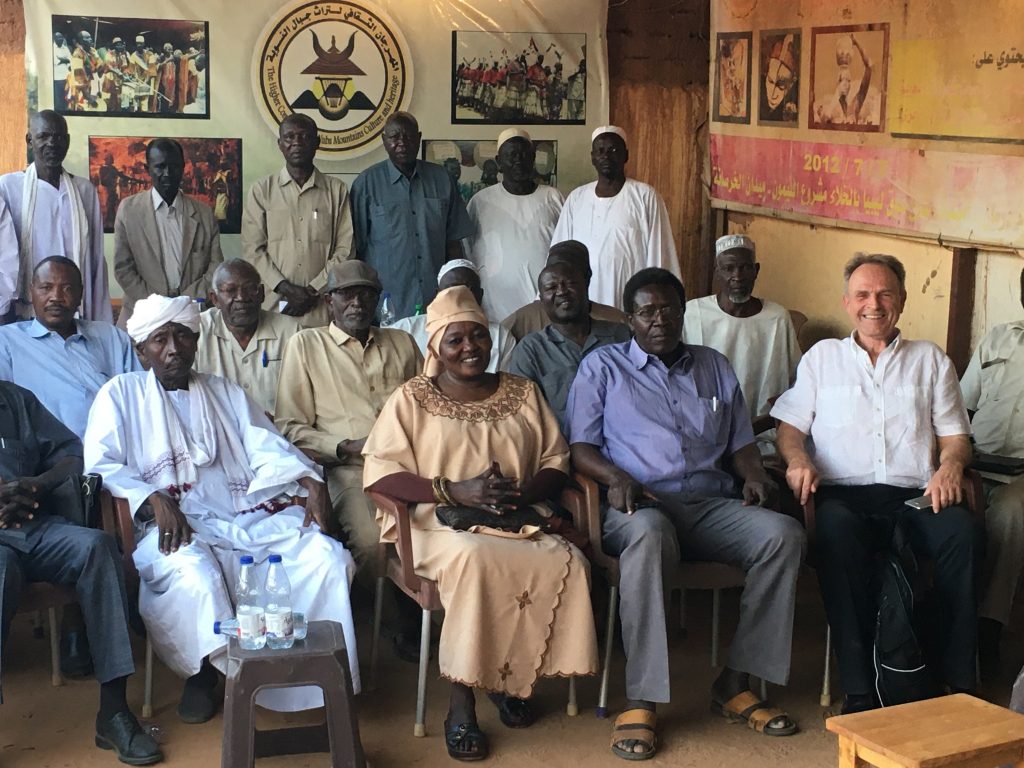
Then, in late November 2021, a large gathering was organised on the premises of Nuba House in Ombadda, al-Chartum (fig. 1). The consultant to the Berlin project group, Valerie Hänsch, supported by the spokesman of the advisory board Kurt Beck, held a discussion with numerous senior members of the Pan-Nuba Council, representing the Nuba communities, who had already come up with their own ideas about the collaboration. Over the course of two days, the participants exchanged views in a lively debate about their mutual expectations of what would be involved. It was at this meeting that the plan to digitise, research and hand over Riefenstahl’s Nuba photographs took on its final form as a collaborative project. The arrangements were subsequently refined in detail and progress was made on digitising the photographs and films at the participating museums in Berlin.
The Sudanese military had instigated a coup shortly before the meeting, on 25 October 2021, deposing the transitional government that had formed in 2019 after protests and the fall of the former military government. Those present at the project meeting hoped nonetheless that political tensions would ease again, making it possible to implement the project in a free and democratic Sudan.
The plan was to conduct joint research and launch a wide-ranging consultation process in the Nuba Mountains and greater Khartoum, with the aim firstly to acquire as many different opinions as possible about Riefenstahl’s photos and recordings from Nuba representatives, and secondly to reach agreement about the approach to the material. In addition, there would be a travelling exhibition, which would open in Khartoum before being shown in the Nuba Mountains and in Sudanese cities with Nuba populations. A further milestone in the plans was envisaged by the Pan-Nuba Council: the construction of a cultural centre in the Nuba Mountains where the digitised photos of Nuba societies would be accessible.
The start of the war on 15 April 2023 between the Sudanese military and the Rapid Support Forces militia brought the entire project to a virtual standstill. The chair of the Pan-Nuba Council recalled the first months of the war: “Everybody was displaced and dispersed throughout the country, many fled to neighbouring countries. There was no communication possible between the members of the Pan-Nuba Council and its executive committee.” Thousands of people were killed by fighting in Khartoum and other cities, while millions were forced to flee. Over 14 million people had been displaced by autumn 2024.
Despite the difficult circumstances, a joint decision was made to at least try to save the project. A member of the Pan-Nuba Council reflects on this as follows: “There was a time when all of us were disoriented whether we [should] continue or not. We were lost and dispersed because of the war. Then we reconnected again. We had long discussions [about] whether we [would be able to] continue with the project or not. At the end we said, we [have to ] keep pushing. This was a historical moment in the life of the project.”
The collaborative work involving joint research and decision-making was always going to be time-consuming and complex in any case, but the war posed a wide range of additional major challenges that were ethical, administrative, financial and structural in nature. Any pre-existing arrangements had to be adapted. Instead of conducting research in Sudan, we relocated the collaboration to a safe neighbouring country and concentrated on smaller focus groups of Nuba representatives, selected by the Pan-Nuba Council.
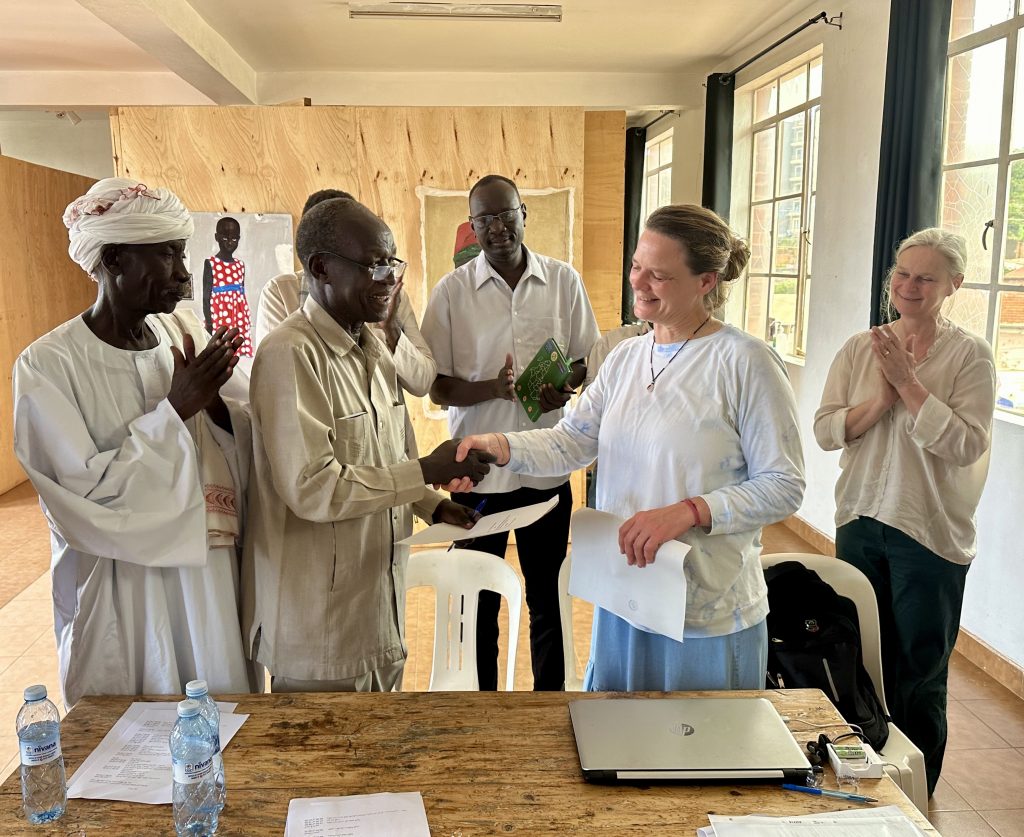
In Kampala, the collaborative work was launched in autumn 2023 with an initial intensive workshop (fig. 2). The success of this meeting encouraged all the participants to push forward with the cooperation. Since then, it has always been necessary to react flexibly to a constantly changing situation so that we can succeed – together, step by step – with the project and its goals, despite the circumstances.
VH
About us
The Pan-Nuba Council (PNC) is a community-based non-governmental organisation established in 2021 by the Nuba community in Khartoum state. Its headquarters is located at Nuba House in Ombadda.
The PNC was set up after a prolonged process that took around eight years to be completed. It was inspired by a public speech that former president Omar al-Bashir gave in 2011, at celebrations for the harvest in al-Qadarif. Following the independence of South Sudan, he stated, Sudan would be an Islamic Arabic country with no place for other cultures. This declaration by the president, alongside other policies that involved opposing and denying the non-Arabic cultures of Sudan and their local languages, is what provoked the Nuba community into action.
Nuba youth activists held a series of meetings to try and find the most suitable response to the president’s declaration. At the first of these they decided to organise a big festival in Khartoum in order to send a message to the government, to other non-Nuba communities and to the international community that South Sudanese independence would not come at the expense of Nuba culture, heritages, languages and Africanism. The Higher Committee of the Nuba Mountains Cultural Heritage Festival was then set up as a means of organising and implementing the festival.
The first festival in 2011 succeeded in achieving the main objective of sending out strong signals to its intended recipients: “We Nuba are here, and our culture should and will remain”. In addition, the various activities presented at the festival proved effective as ways of consolidating our culture and identity. At the first evaluation meeting, the attendees passed a resolution that the festival should continue on an annual basis, with the Higher Committee providing additional members to represent most, if not all, of the Nuba communities.
That committee was able to host four festivals before the war started in April 2023. Those present at the evaluation meeting also proposed setting up a Nuba community-based body that would work towards unifying Nuba communities, and suggested that it be called the Pan-Nuba Council (PNC). Moreover, during that same meeting a committee was formed from among Nuba community leaders to supervise the establishment of the PNC; another committee was created from members of the Nuba lawyers’ union to prepare the PNC’s draft constitution and regulations.
After eight years of ongoing work and a series of meetings the committee was able to convince 65 out of the 82 Nuba communities to join and send their representatives: 25 people from each community, with five each in the categories of youth and students, women, community figures, community leaders and intellectuals. A general assembly was then set up that approved the constitution and the regulations and elected members of the plenipotentiary council and executive committee.
The plenipotentiary council represents the general assembly in its absence or in emergency situations. The executive committee includes the chairman and the deputy chairman plus 18 secretariats (general secretary, finance, statistics, religious affairs, women and children’s affairs, youth, and so on). The PNC has branches in the states of White Nile, River Nile and Gezira, with plans to establish offshoots in other states where considerable numbers of Nuba people live.
The Stiftung Preussischer Kulturbesitz (Prussian Cultural Heritage Foundation) is an internationally renowned cultural institution and a key player in the humanities and the social sciences. It runs museums, libraries, archives and research institutes whose collections have a universal character, documenting the evolution of human culture from its beginnings to the present day in Europe and on other continents. While these collections had their roots in Brandenburg and Prussia, they have since grown exponentially. Today, the foundation is making a crucial contribution towards reshaping Berlin’s historical centre. It is responsible for five institutions that between them represent every aspect of cultural tradition: the Staatliche Museen zu Berlin (National Museums in Berlin), the Staatsbibliothek zu Berlin (Berlin State Library), the Geheimes Staatsarchiv Preussischer Kulturbesitz (Prussian Secret State Archives), the Ibero-Amerikanisches Institut (Ibero-American Institute) and the Staatliches Institut für Musikforschung (State Institute for Music Research).
The Ethnologisches Museum (Ethnological Museum) evolved from the royal cabinets of art, and since its establishment in 1873 has become one of the largest and most significant collections of its kind worldwide. The museum’s holdings comprise approximately 500,000 ethnographic, archaeological and cultural history objects from Africa, Asia, America and Oceania. They are complemented by some 500,000 media items (ethonological photographs, films, audio recordings) and about 200,000 pages of written documents. Many of its collections are among the most extensive and valuable in existence. The Ethnologisches Museum has joined forces with the Museum für Asiatische Kunst (Asian Art Museum) and other institutions such as Stadtmuseum Berlin and the Humboldt-Universität zu Berlin, launching an innovative concept to present their collections at the Humboldt Forum on Schlossplatz in the heart of Berlin.
The Kunstbibliothek (Art Library) is an interdisciplinary research facility with one of the world’s largest museum libraries. Above and beyond this, it boasts valuable collections on the histories of architecture, photography, graphic design and fashion, and on book art and media art. Together, the library and the various museum collections it holds represent the full spectrum of source material for conducting research on art and culture. Interdisciplinary networking and supplying related literature lie at the heart of the Kunstbibliothek’s mission. Its research activities and exhibitions provide new perspectives on the histories of visual media, architecture, fashion and the art trade, as well as the shared origins of Western and non-European art. The Kunstbibliothek has a network of facilities whose holdings are found at three separate venues in Berlin: the museum collections and the Kunstwissenschaftliche Bibliothek (Library of Art History) are situated at the Kulturforum near Potsdamer Platz; the Archäologische Bibliothek (Archaeological Library) houses the Archäologisches Zentrum; and the Sammlung Fotografie (Collection of Photography) is exhibited in the Museum für Fotografie (Museum of Photography).
The Staatsbibliothek zu Berlin (Berlin State Library) is the largest universal scholarly library in Germany, with more than 25 million works across various media. It collects and preserves manuscripts, printed works and digital works from all the different areas of scholarship, languages and countries. The Staatsbibliothek zu Berlin is a central source of national and international literature. It maintains extensive holdings in every discipline, with collections that include books, manuscripts, autographs, maps, prints, photo albums, newspapers, literary estates, electronic resources and much more. One particular treasure is the score of Beethoven’s Ninth Symphony, which is listed in UNESCO’s Memory of the World register. Literary and scholarly estates and bequests as well as the extensive archives of publishing houses are catalogued and evaluated by scholars at the Staatsbibliothek. Its holdings, including databases and other electronic resources, are constantly growing.
Deutsche Kinemathek is one of Europe’s leading institutions for audiovisual heritage. In 2025 it will relocate to E-Werk in the central Mitte district of Berlin while planning for its new permanent premises is ongoing. At this temporary site, the Kinemathek will present a programme that blends established formats with innovative concepts, offering insights into film and television culture that never fail to fascinate. Deutsche Kinemathek supports the exploration of the moving image with a diverse programme of education and events. As central points of contact for research and science, its archives and specialist library will remain accessible. The film distribution library, which lists some 20,000 titles, continues to be an important part of the institution, alongside film seasons and festivals. Up until 31 October 2024, the Kinemathek housed a permanent exhibition on German film and television history in its Museum für Film und Fernsehen (Museum of Film and Television), supplemented by temporary shows on special themes. This exhibition is set to reopen at E-Werk in the second half of 2025.